
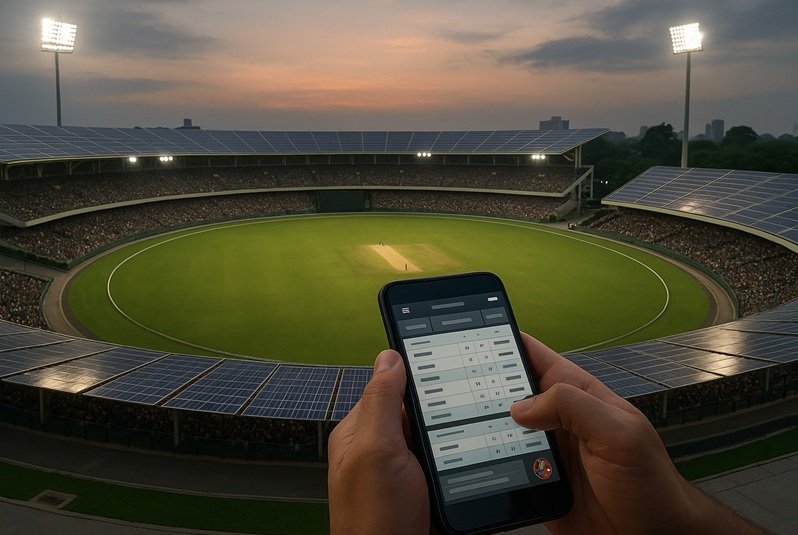

On humid evenings in Bengaluru or Dhaka, the floodlights still carve the same bright circles into the sky, yet what powers that light is slowly changing. In two of the world’s most climate-exposed countries, sport can no longer pretend the weather is just background noise. Stadium roofs carry solar panels, hidden pipes pull rainwater away before it kills a match, and administrators speak of kilowatts and waste audits along with strike rates.
India’s solar rooftops and green cricket agenda
The clearest symbol of this shift is M. Chinnaswamy Stadium in Bengaluru. In 2015, the Karnataka State Cricket Association completed a 400 kW rooftop solar power plant that feeds electricity into both the venue and the city grid, significantly cutting the stadium’s conventional power use. Reports over the last few years show that this system now generates a large share of the ground’s daytime energy and saves the association substantial costs each season. The same stadium also uses rainwater harvesting and better waste management, which is why it is routinely cited as one of the most eco-conscious cricket venues in the world.
Chinnaswamy is not alone. In Hyderabad, the Rajiv Gandhi International Cricket Stadium has installed solar power and rainwater harvesting systems and relies on subsoil drainage to clear surface water quickly when storms hit. At the national level, the Board of Control for Cricket in India signed an agreement with UN Environment in 2018 to “green” cricket operations, including phasing out single-use plastics and applying a zero-waste protocol at selected matches. These steps are not yet a full revolution, but they turn sustainability from a slogan into a series of practical checklists that venue managers must follow.
Bangladesh: drainage, rooftops, and a climate frontline
For Bangladesh, climate pressure is even sharper. Rising seas and violent rains shape everyday life, so a stadium that cannot cope with water simply cannot survive. Sher-e-Bangla National Cricket Stadium in Mirpur was rebuilt with a sand-based outfield and underground drainage that lets water sink straight down, allowing play to restart quickly even after heavy showers. That reliability has protected domestic leagues and international series from being washed away on days when older grounds would have stayed under covers.
Beyond the boundary rope, national policy is pushing hard on rooftop solar. Bangladesh’s government has set a goal of meeting 40 percent of its electricity demand from renewables by 2041 and is relaxing net metering rules so that more households and businesses can send surplus solar power into the grid. In July 2025, a National Rooftop Solar Programme was announced, targeting 3,000 MW of capacity on government buildings, schools, and hospitals as part of broader renewable energy milestones for 2030 and 2040. Local engineers have already examined how rooftop photovoltaic systems might work on major urban structures; stadiums like Sher-e-Bangla naturally fit into that conversation, even when projects are still at the feasibility stage.
Fans, digital rituals, and lighter footprints
Many supporters in cities such as Kolkata, Bengaluru, or Chattogram now mix live attendance with nights when they stay home, stream games, and argue about tactics in group chats. When they choose the sofa over the traffic jam, their climate impact shrinks almost without effort.
During those evenings, sport and technology blend into a single ritual. Some fans study statistics and weather data before a game, then test their predictions through a licensed betting app while the match unfolds on television or a laptop. Within the same interface, they can step into casino sections filled with slots, card tables, and live dealers during innings breaks or at halftime, turning a quiet night into something closer to a festival without adding noise or waste around the real stadium.
Digital sportsbooks and the quiet rise of virtual arenas
As smartphones become the main ticket into global sport, online operators sit beside broadcasters as part of the normal landscape. Frequently, cricket followers in Chennai or Dhaka who look for stable odds, multiple payment options, and a simple registration process, choose melbet download to follow pre-match and in-play markets for tournaments such as the Indian Premier League or Bangladesh Premier League. Because all of this sits inside a regulated framework with licensing, age checks, and customer support, betting and casino play become structured forms of entertainment rather than chaotic risks.
Green arenas as a shared direction
Sport in India and Bangladesh is learning to live with the climate rather than pretending to stand outside it. At the same time, digital viewing and regulated betting ecosystems allow more fans to experience the drama from home, easing some pressure on crowded streets and fragile urban infrastructure. The result is not a perfectly clean game yet, but a region where each new season quietly shifts more of the load from fossil fuel to sunlight, from waste to reuse, and from impulse to informed choice.